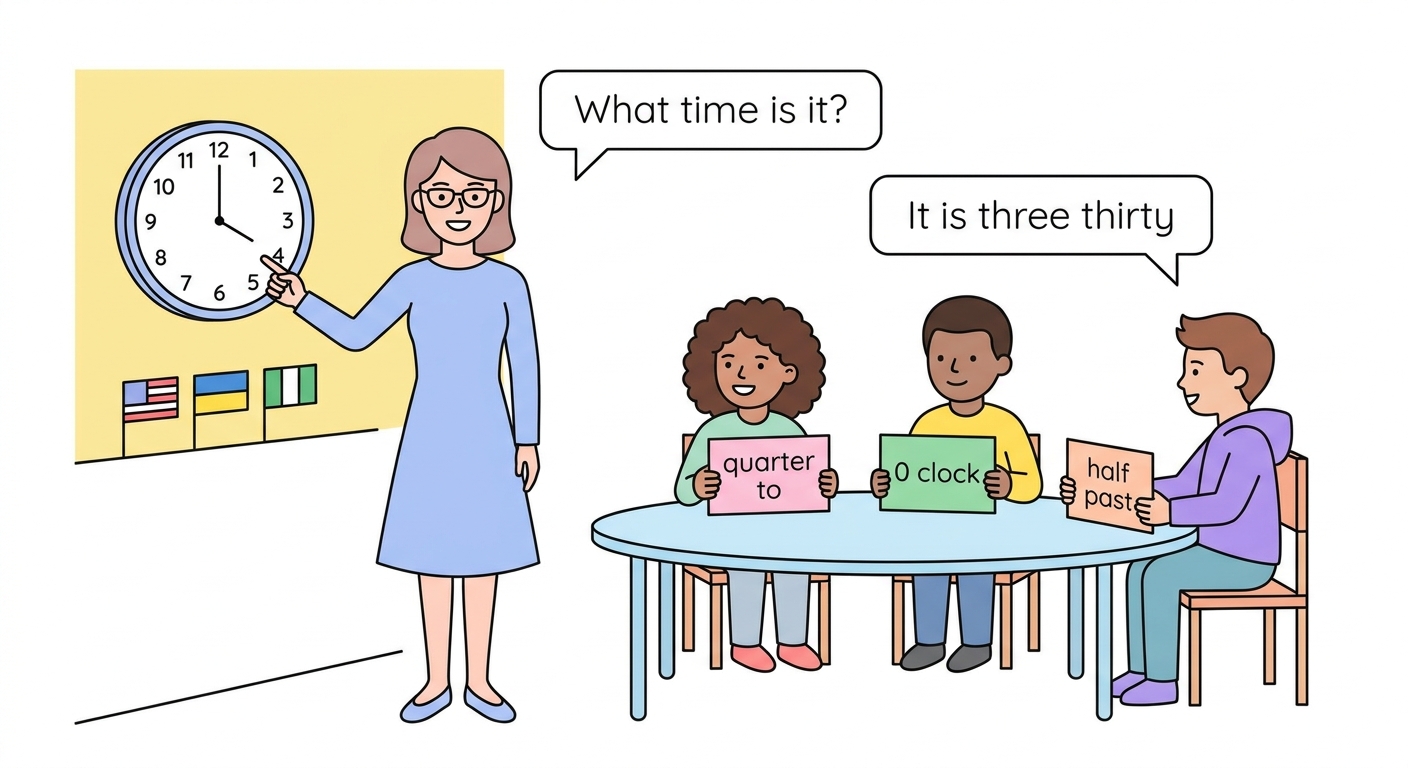
Time and Language: A Natural Connection
For English language learners, telling time isn't just a math skill — it's a vocabulary and communication skill. Students need to learn both how to read clocks and how to express time in English, including phrases like "quarter past," "half past," and "ten to." Time Bingo bridges this gap by combining visual recognition with language practice.
Essential Time Vocabulary
- Numbers 1-12: Foundation for reading clock faces
- O'clock: "It's three o'clock"
- Half past / thirty: "It's half past four" or "It's four thirty"
- Quarter past / quarter to: "It's quarter past six"
- Minutes past / minutes to: "It's twenty minutes past seven"
- AM / PM: Morning vs. afternoon/evening
- Noon / midnight: Special times
Using Time Bingo with ESL Students
Time Bingo excels as an ESL tool because it provides comprehensible input — students see the digital time, hear it called, and must match it on their card. This multi-modal approach supports language acquisition naturally.
Lesson Plan Framework
- Warm-up (5 min): Review time vocabulary with flashcards
- Teach (10 min): Model reading times on analog and digital clocks
- Play (15 min): Play Time Bingo online or with printed cards
- Practice (10 min): Students write sentences using times from the game
- Wrap-up (5 min): Tell a partner three things they do at specific times
Differentiation by Proficiency Level
Beginning: Easy mode with whole hours. Focus on numbers and "o'clock." Use strategies from our kindergarten activities adapted for ESL.
Intermediate: Medium mode. Introduce "quarter past," "half past," and "quarter to." See our time expressions guide.
Advanced: Hard/Expert mode. Practice full time expressions, AM/PM concepts, and elapsed time questions.
Additional Resources
ESL students who also have learning differences will benefit from our special education resources and adaptive tools. For ESL families doing home instruction, the homeschool curriculum guide provides a structured progression.