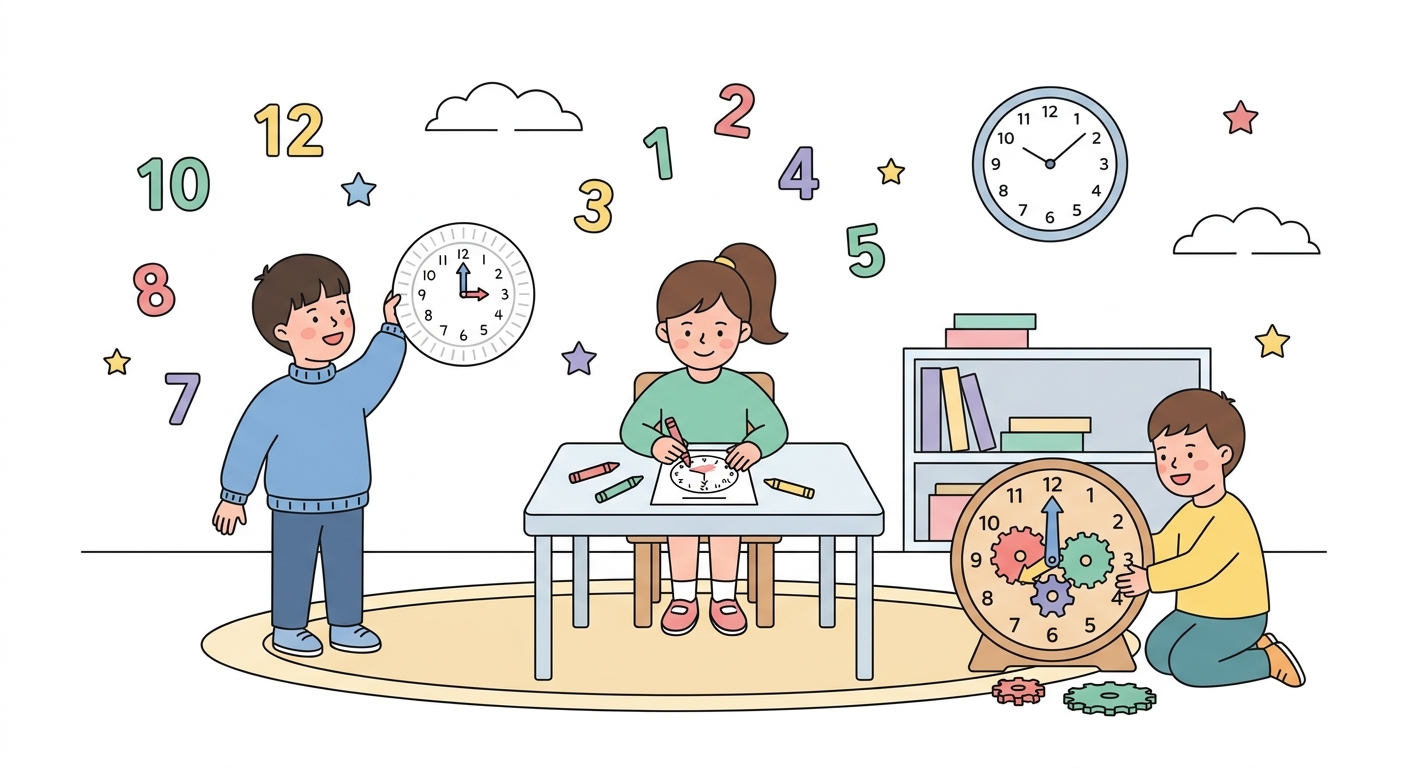
Getting kindergarteners excited about telling time doesn't require fancy materials. The best activities are hands-on, playful, and connected to children's daily lives. Whether you're a classroom teacher or a parent working with your child at home (see our hands-on home activities guide), these proven methods make learning time fun and memorable.
Activity 1: My Day Clock
Create a large paper plate clock with your students. Around the edge, help them draw or paste pictures of daily activities at the corresponding hours: breakfast at 7, school at 8, lunch at 12, home at 3. This connects abstract clock positions to concrete experiences — the same approach used in visual schedule activities for special education.
Activity 2: Time Bingo Game
Print time bingo cards using the Time.Bingo Printable Generator on Easy difficulty. Call out times like "three o'clock!" and have students find and mark 3:00 on their cards. For a digital version, create an online game room and project it on the classroom screen.
Activity 3: Clock Scavenger Hunt
Send students on a classroom scavenger hunt to find all the clocks. At each one, they draw what they see and write the time with help. This builds awareness that clocks are everywhere — a great precursor to the daily schedule practice activities used in homeschool settings.
Activity 4: Human Clock
In the gym or playground, create a giant clock on the floor with tape. Students take turns being the "hour hand," pointing to the called number. This kind of kinesthetic activity works especially well for sensory learners.
Tips for Success
- Keep sessions to 10-15 minutes for this age group
- Use real analog clocks alongside activities
- Celebrate all attempts, not just correct answers
- Ready for more? Move on to structured clock games for 5-year-olds