Teaching Time at Home
One of the greatest advantages of homeschooling is the ability to teach time in context — throughout the day, in real situations, with real clocks. Rather than isolated worksheets, homeschool families can weave time-telling practice into cooking, schedules, travel, and everyday routines.
Scope and Sequence for Time
- Ages 4-5: Clock awareness, daily routines linked to times, counting to 12
- Ages 5-6: Whole hours (o'clock), introduction to the hour hand
- Ages 6-7: Half hours (:30), both clock hands, digital vs. analog
- Ages 7-8: Quarter hours, time to 5 minutes, AM/PM
- Ages 8-9: Time to the minute, elapsed time, reading schedules
- Ages 9+: Time zones, 24-hour clock, time calculations
Multi-Age Time Bingo Sessions
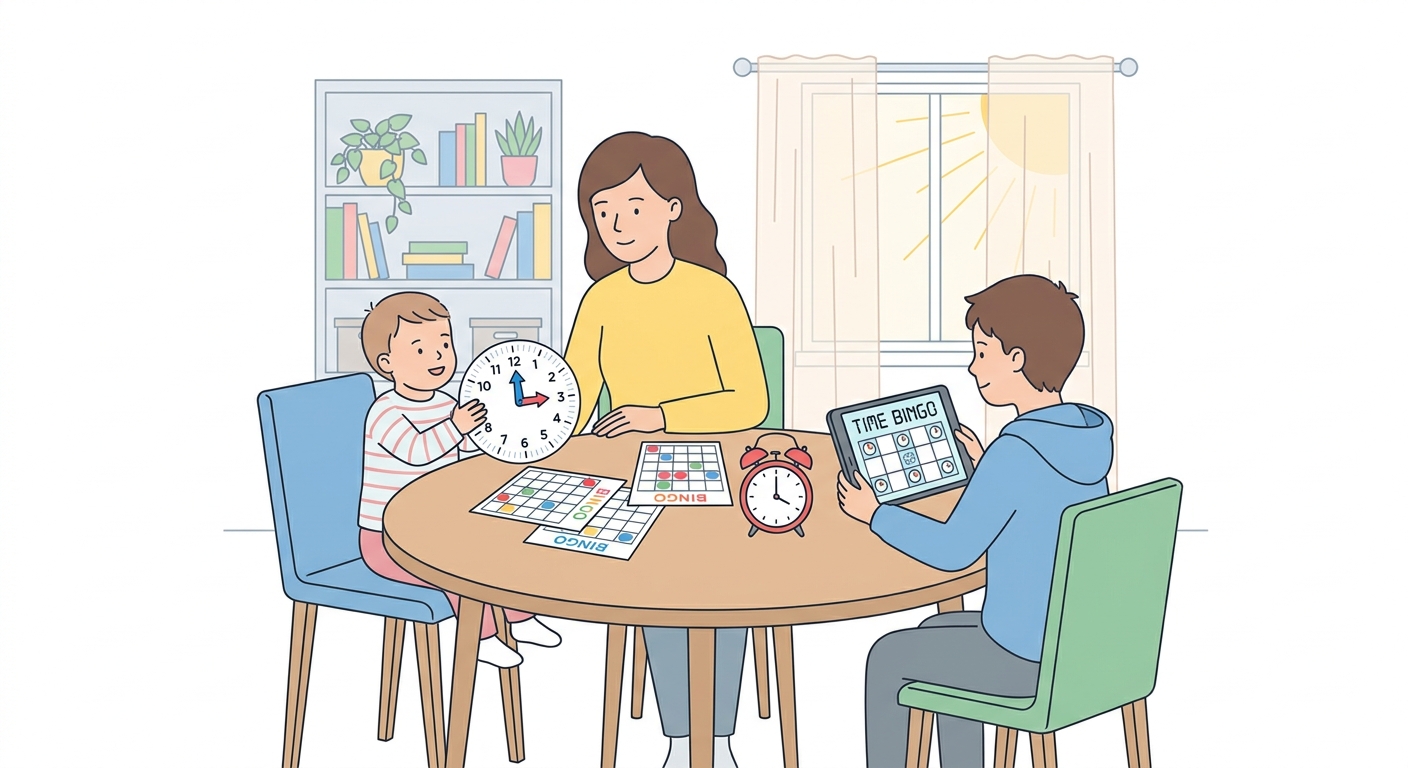
For families with children at different levels, Time Bingo is ideal:
- Print differentiated cards: Use the Printable Generator to create Easy cards for younger kids and Hard cards for older ones
- Online rooms: Create a family game room where everyone plays on their own device
- Buddy system: Pair an older child with a younger sibling
Integrating Time into Daily Life
- Morning routine: "What time is it? When does math start?"
- Cooking: "Set the timer for 25 minutes. What time will it be done?"
- Screen time: "You can watch until 4:30. How many minutes is that?"
- Travel: "We need to leave at 3:15. How much time do we have?"
Record Keeping
Document progress for your portfolio. The IEP goals framework from our special education resources works well for structured progress tracking.
Additional Resources by Age
Match instruction to level: Kindergarten (ages 4-6) for clock awareness, 2nd Grade (ages 7-8) for 5-minute intervals. If your child has learning differences, our special education resources offer adaptive strategies. For bilingual families, the ESL time resources help build English time vocabulary alongside math skills.